
In the past two decades, the way we find information online has been dominated by traditional search engines. We typed a keyword into Google, received a list of results, and clicked on the most relevant links.
Today, however, something is changing.
More and more people are no longer searching for information only through search engines, but are asking questions directly to AI: ChatGPT, Gemini, Perplexity, and other systems based on language models. In this new context, a new concept emerges: Generative Engine Optimization (GEO).
It does not replace SEO.
It complements it.
And it helps brands to be present in the AI-generated responses.
From the search engine to the answer engine
When we use a traditional search engine, we receive a list of results to explore.
When we use a generative AI system, however, something different happens:
the AI directly synthesizes a response using information from the web.
This means the user doesn't always click on multiple sites to find what they are looking for.
Often, they get an immediate answer.
According to Gartner, by 2026 the volume of searches on traditional engines could decrease by up to 25%, precisely due to the growing adoption of chatbots and conversational AI systems.
Source:
https://www.gartner.com/en/newsroom/press-releases/2024-02-19-gartner-predicts-search-engine-volume-will-drop-25-percent-by-2026-due-to-ai-chatbots
This does not mean traditional search will disappear, but that the landscape of online discovery is becoming broader.
And brands need to be present in the AI-generated responses as well.
What is Generative Engine Optimization
Generative Engine Optimization (GEO) encompasses strategies and analysis that help a brand to:
understand if it appears in AI responses
analyze how it is described
improve its presence in generative AI systems
In practice, while SEO works to make a site visible in search engines, GEO focuses on analyzing and enhancing visibility in AI responses.
The two disciplines are not in competition.
They are complementary.
SEO remains essential for web traffic and search engine presence.
GEO helps to understand how AI models interpret and narrate a brand.
Why visibility in AI is becoming important
In recent years, the use of artificial intelligence to seek information has grown rapidly.
According to various industry analyses, millions of users rely daily on chatbots and AI systems to:
ask for product recommendations
compare software tools
find services
get quick explanations
Source:
https://www.semrush.com/blog/ai-search-trends/
For example, when someone asks:
“What are the best tools to analyze a brand's visibility in AI?”
the answer is no longer a list of links but a concise explanation generated by the model.
In this scenario, it becomes important to understand:
which brands are mentioned
which are excluded
how they are described.
How AIs build their responses
Language models do not invent information from scratch.
Their responses are based on a combination of:
data available on the web
authoritative sources
structured content
articles and documentation
databases and knowledge graphs
For this reason, the online presence of a brand — content, citations, articles, documentation — contributes to building the perception that AI provides to users.
Understanding how this information is interpreted by models is one of the most interesting challenges for companies and marketing professionals.
The role of SEO in the AI era
In this new scenario, SEO continues to be crucial.
SEO-optimized content remains one of the main sources of information used on the web.
Many of the insights that feed AI models come from:
articles
authoritative websites
technical documentation
editorial content
For this reason, SEO and GEO can work together.
SEO helps build a solid and authoritative online presence.
GEO helps understand how that presence is interpreted and used by AI.
A new metric: AI Visibility
Traditionally, brands monitor metrics like:
organic traffic
Google ranking
impressions
clicks
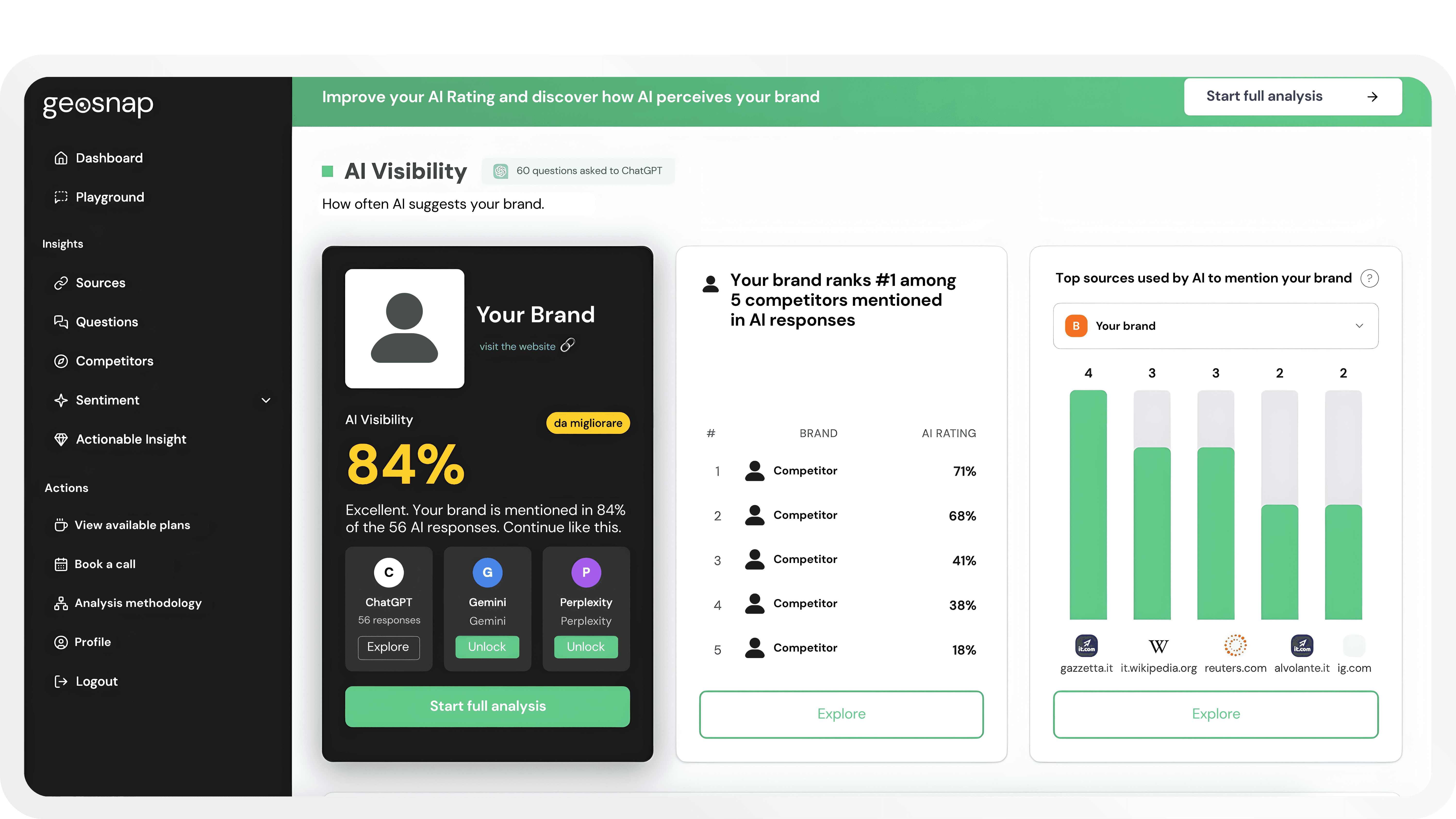
With the advent of AI search, a new dimension is added: visibility in AI-generated responses. We can call it AI visibility.
It means understanding:
if the brand appears in responses
how often it is mentioned
in what contexts it is mentioned.
These insights allow companies to better understand how they are perceived in the new AI ecosystem.
Why companies are starting to monitor AI visibility
Increasingly, decisions — especially in the software, technology, and services sectors — begin with a question asked to an AI system.
Very common examples are:
“What are the best CRMs for startups?”
“What tools analyze brand visibility in AI?”
“What platforms help monitor online reputation?”
If a brand frequently appears in these responses, the likelihood of being discovered by new users increases.
If it does not appear, it risks remaining invisible in a growing part of the digital ecosystem.
A new field of analysis for companies and professionals
Generative Engine Optimization opens a new area of analysis for:
companies
marketing teams
agencies
digital professionals.
Understanding how AI systems interpret the web becomes an increasingly useful skill for analyzing a brand's digital presence.
It's not about replacing existing strategies, but about adding a new perspective.
Conclusion
The evolution of AI search is raising new questions for businesses and professionals.
Beyond the presence on traditional search engines, it is becoming increasingly important to understand how brands are represented in artificial intelligence systems.
AI visibility analysis platforms, like GeoSnap, enable users to explore this new ecosystem and gain a better understanding of how AI models interpret and present companies to users.
In a context where online search is becoming increasingly conversational, this perspective can offer valuable insights for analyzing and understanding a brand's digital presence.

Rinald Sefa
Co-founder - CMO
Read more...